
Challenging behavior was identified among the top three stressors in early childhood care in a 2023 study by University of Virginia Professor Lieny Jeon. This is consistent with what has been reported from Nebraska’s early childhood professionals and family members. When caregivers are stressed, it can have significant and long-lasting repercussions, including difficulty with children knowing how to experience and regulate their emotions, strained relationships between the parent/caregiver and child, and negative influence on a child’s physical and mental health.
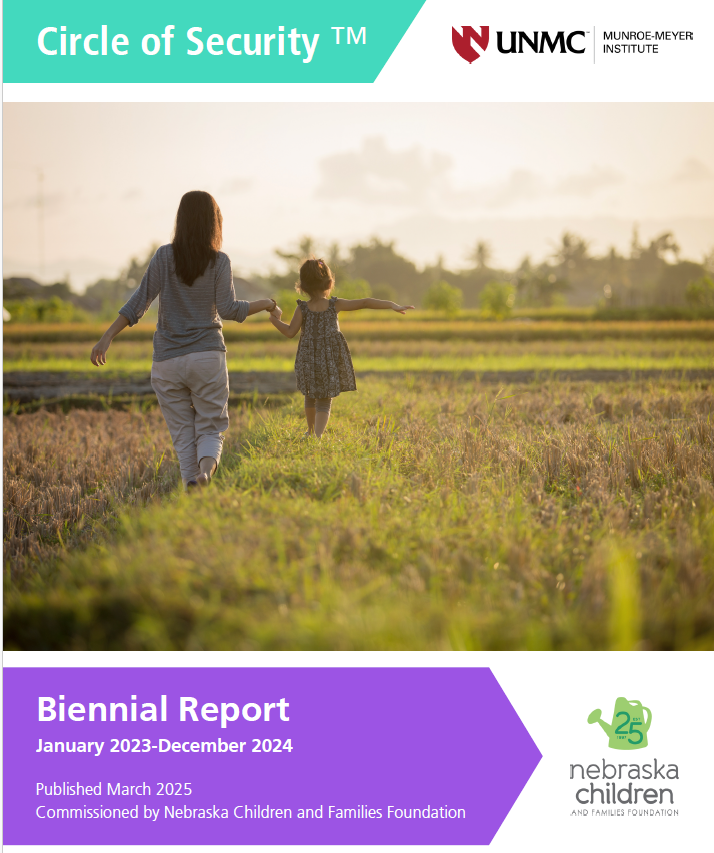
That’s why a recent joint evaluation by Nebraska Children and Families Foundation and the Munroe Meyer Institute has been so encouraging for Circle of Security, an evidence-based program supported by Rooted in Relationships. Circle of Security started its first programs in Nebraska 14 years ago, and, in 2014, trained 114 facilitators. In 2015, Rooted began supporting the program’s infrastructure, including newsletters, conference calls, a statewide website, and evaluation materials. Since then Circle of Security has expanded, adding 96 more facilitators and peer reflective consultation in 2017, and incorporating both Circle of Security Parenting (COSP) and Circle of Security Classroom (COSC) into statewide trainings.
Many COSP participants said they joined the program to improve their parenting skills, strengthen parent-child relationships, and gain a better understanding of their children. The evaluation showed that 89% of 789 participants in COSP felt that meeting with a group of parents was helpful, and that measurements taken before and after training showed: significant reductions in their level of parent stress; increases in the ability to recognize negative response behavior and to identify and respond to children’s needs; and developed a greater capacity to repair relationships and to step back and think. One parent commented, “It was such a great class that reminded me of important parenting strategies, reaffirmed what I was doing well, and gave me the tools to strengthen my relationships with my children.”
The COSC cohort of early childhood educators, who largely wanted to better help, communicate with, and serve the children in their care, were equally enthusiastic, with 93% responding that it was helpful to meet as a group of professionals. There were similar significant changes in the COSC pre- and post-training evaluations, including: decreases in the level of teacher stress; increases in positive teacher-parent relationships and gained confidence in meeting children’s needs; and more capacity in the ability to repair relationships and to recognize negative response behavior. Comments from participants ranged from “I love to understand the Circle,” to “It was one of the most eye-opening trainings I’ve been a part of.”
Clearly, Circle of Security training is making a difference in the lives of parents and educators and in the children they care for. Because both the COSP and the COSC groups report feeling less stress following training and are more confident in their relationship-building skills, the results suggest a concomitant positive impact on children’s emotional, mental, and physical well-being. Certainly, those who participated seem happy with the training. As one provider said, “I want to thank Rooted for this professional development opportunity. This course will be so helpful in all the programs I teach and in my reflective practice consultations.”
© 2025 Nebraska Children and Families Foundation. All rights reserved.

Nebraska Children’s mission is to create positive change for Nebraska’s children through community engagement.


 Growing the Good Life
Leave a comment