

Ryan Jaime’s class of three-year-olds is excited. “What’s the first step?” he asks. Some put their hands in the air. Others can’t help calling out, “what am I feeling!” Jaime is an early childhood educator at Trucks N Tiaras Intergenerational Academy, and, for several weeks, he has been preparing his kids for a special visit. Later that day, in another part of North Platte, something similar is happening. Monica Carter, an 11-year public preschool teaching veteran, has her class take three big breaths along with their honored guest.
The guest is a 6-foot turtle named Tucker, and he is part of a social-emotional development program offered through Rooted in Relationships to reinforce Pyramid Model strategies that teach children how to self-regulate their big emotions. For weeks prior to the visit, these early childhood professionals have been preparing their children: they’ve read the story again and again; they’ve practiced the steps of stopping, taking three deep breaths, and tucking into your shell until you can calm down and find a positive solution; they’ve asked questions like “How old is Tucker?” and “How big is Tucker?”
So in January, when Tucker came to visit North Platte, they were ready. They listened to his story; they practiced his calming steps; they gave Tucker high-fives; and they took photos.
Carter, who is part of the Lincoln County Early Childhood Mental Health Committee and who went through Pyramid Model training, says, “behaviors have changed so much over the last 10 years. We just needed a new strategy.” To address the rise in negative behaviors in childcare settings, Rooted began offering Pyramid training, with Tucker Turtle as one of its primary tools. Carter says, “there’s Tucker at school and Tucker at home as a social story to teach kids how to take three deep breaths and tuck into their shell, and if there is a problem, instead of getting angry, they find a solution.”
Carter believes these methods of shifting away from distracting behaviors have allowed her to focus more on the positives. She tells the story of a boy who hit and yelled when she started working with him. Now, rather than punch or scream, he just sits until Carter asks, “Do you need some help? How are you feeling? You look upset.” She says they then talk about his feelings.
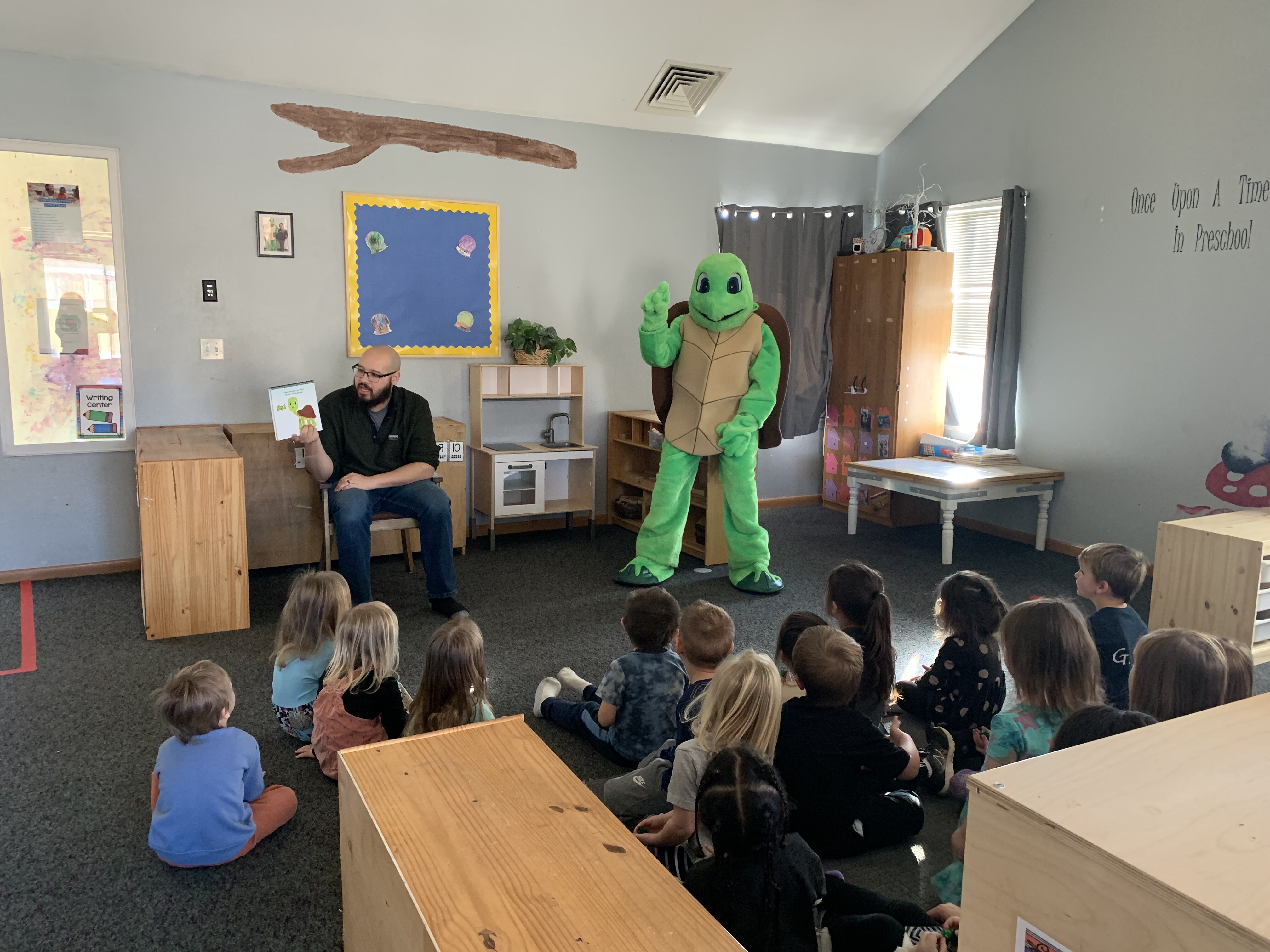
Jaime also sees significant changes in his children. He said, “we’ve been using it (Tucker Turtle) in my classroom to really help the kids work through those big emotions.” He has been involved in Pyramid Model training and says that he likes any extra training that helps him provide better quality care. And like Carter, he sees it making a difference. Jaime says, “one of my particular kiddos has been going through a transition just in his own life and home. The change has been hard for him, and using the Tucker Turtle method has really helped him.” He points out that it has become a family bonding opportunity as the boy’s older school-aged sister will come in at pick-up time and say, “yeah, I read him the story the other day, and he was able to take three deep breaths!”
Tucker’s visit and the work Rooted in Relationships has been doing in North Platte aim at that sort of family and community bonding. That’s why the January event wasn’t just about visiting schools that are part of Rooted. Anne Price, Children’s Librarian at North Platte Public Library, has worked with Rooted on a twice-a-year “Play is the Way” event and also met Rooted’s Regional Coordinator Jen Pfeifer on the same Lincoln County Early Childhood Mental Health Committee that Carter is a part of. Price was thus happy to host two story times at the library during Tucker’s visit.
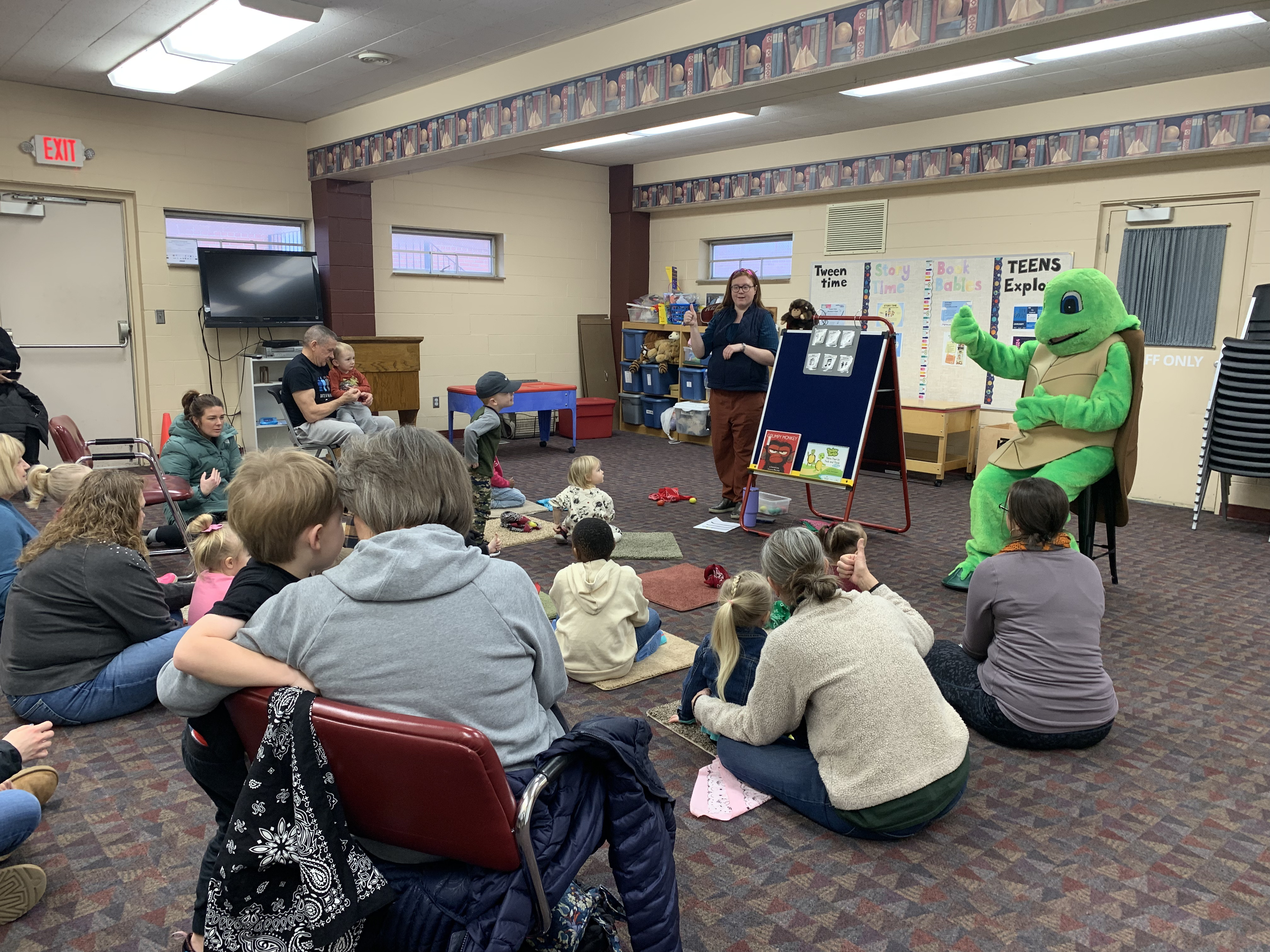
Price said she saw “a potential missed group of caregivers that the library had access to that maybe didn’t know about Rooted.” She targeted this group in her invitations and even built bridges for future Rooted connections when a center contacted her and asked if Tucker might be able to visit them even though they weren’t involved with Rooted. Price put the center in touch with Pfeifer, who said, “we did visit that center with Tucker Turtle and did make that connection.” As a result, the center is interested in being a part of the Rooted expansion that will begin in the area in 2025 and has asked to be put on the organization’s listserv.
Price sees the library as a natural pivot point for Rooted in the community not only because she can include event’s like the Tucker reading, but also because she sees “lots of families who homeschool and things like that,” so she could bring Pyramid resources to them. Furthermore, she emphasizes that “a lot of the children I see on a regular basis, the library is their first interaction with community spaces, the idea of shared spaces and shared materials.” Unlike their homes, where they are in charge of the environment, the library offers new challenges and “Tucker and the Pyramid Model are good with engaging kids on how to regulate their emotions in new surroundings.” The library then becomes a touchpoint for teaching and reinforcing the lessons they learn in care settings.
Pfeifer said that the event reinforced, for classrooms that use Tucker, those steps to help children self-regulate their emotions. But she also said that she feels like expanding beyond care settings to places like the library created outreach to families whose children aren’t in schools or care settings, giving them important resources. She called the library a “great partner,” and Price returned the compliment, saying “I think the library and Rooted are a great partnership. I’m excited to see how we can grow together.”

Pfeifer said of Tucker’s visit, “we saw over 150 kids for the event. That’s a pretty big impact for North Platte.” In addition, the children in schools where Tucker visited and the families that attended the library readings received copies of the Tucker Turtle book. The community response was certainly strong. Jaime said, “I feel like we’ve never been in a better place,” and then added, “behaviors have gotten way better.” Price said she had “a very positive impression of the event and a very positive impression of Rooted.” Perhaps more telling was the response she received from a grandmother after one of the readings, who said, “we really could have used this yesterday around nap time.”
The Tucker Turtle event was not only successful then at giving educators, children, and families important tools to cope with big emotions and challenging behaviors, but also at creating connections within the community and raising awareness of early childhood mental health. As it celebrates 10 years of supporting communities, this is the kind of outreach Rooted in Relationships looks to create.
Learn more about Rooted in Relationships

Nebraska Children’s mission is to create positive change for Nebraska’s children through community engagement.


 Growing the Good Life
Leave a comment