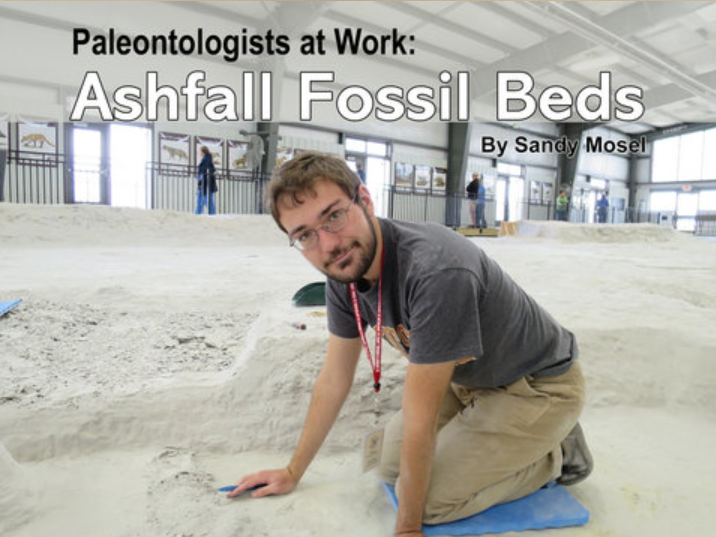
When children pick up a picture book about paleontologists digging for fossils, they’re not just learning vocabulary or learning to read—they’re discovering that science happens right in their own backyard. That’s exactly what happened when two Nebraska women collaborated to create a children’s book “Paleontologists at Work: Ashfall Fossil Beds,” bringing together early literacy and hands-on science in a way that makes both accessible to our state’s youngest learners.
The Nebraska Growing Readers (NGR) program encourages early literacy and shared reading between caregivers and young children while giving Nebraskans the opportunity to contribute stories to the program’s library. The recently published book about Ashfall Fossil Beds showcases how NGR can connect children to their state’s natural treasures while building essential reading skills.
A Perfect Match: Fossils and Early Readers
Amy Napoli is an Associate Professor & Early Childhood Extension Specialist at UNL. She holds a PhD in Human Development and Family Studies and researches ways to strengthen learning environments for young children, saw an ideal opportunity when planning for her team’s 2026 Collaborative Summer Reading Program. The theme “Unearth a Story” focuses on dinosaurs and paleontology—topics that naturally captivate young minds.
“We have so many resources in Nebraska through the University of Nebraska State Museums and amazing faculty studying paleontology,” Napoli explains. “We really want to show children that the study of fossils and history isn’t some far off concept—it happens every day right here in our state!”
The concept goes beyond simply reading about science. It’s about helping children see themselves as scientists and showing them that the wonders they read about in books exist just down the road.
From Museum Guide to Author
Sandy Mosel brought a unique perspective to the project. With 35 years of experience working at Ashfall Fossil Beds, she has spent thousands of hours giving school tours and watching children discover the excitement of paleontology. When asked to write a book on paleontology for the Nebraska Growing Readers initiative, she drew on decades of connecting with families and young visitors.
Mosel’s path to authoring this book was unconventional. Starting with a two-year associate degree, she was initially hired at Ashfall Fossil Beds in 1991 for office work and gift shop duties. But when Ashfall Park’s opening attracted more visitors than expected, she took on additional responsibilities. “I was privileged to receive a lot of on-the-job training,” she says. Her experience working with children through family, church, and school activities prepared her to take on educational tours.
Children’s Curiousity
Creating a book for preschoolers presented unique challenges. Mosel began with a simple question that speaks to every child’s natural curiosity: Have you ever wondered what was here before you were here?
“All children wonder about things, even before they have words to express what they are thinking about,” Mosel notes. She introduced essential vocabulary like “paleontologist” and “fossil” while using photos to help young readers connect words with concepts. The pictures show real paleontologists at work and actual fossils, making abstract ideas concrete for developing minds.
The hardest part? “Using a minimum number of words to explain big ideas,” Mosel admits. “Writing for young children is hard because you have to get to the bare bones of an idea or concept.” But this constraint helped her focus on the core message.
A Collaborative Process
Nebraska Growing Readers provides writers workshops to selected partners and this played an important role in bringing the book to completion. “Setting up regular meetings as a group helped us stay on track and make sure the book remained a priority,” Napoli says. NGR staff and workshop leader Greta Carlson provided valuable feedback that helped shape the final product.
The timeline was remarkably tight. Mosel was given six days to complete an initial draft with photos but finished in just four. After a couple of weeks of text revisions with Napoli’s team and minor photo adjustments, the entire process took about four weeks.
Most of the photos feature summer interns who have worked at Ashfall over the years, their enthusiasm for paleontology evident in every image. Even the illustrations came from an intern who is a gifted artist, creating artwork that had been used to update museum exhibits.
Building Bridges Between Books and Experience
Both Mosel and Napoli hope the book will do more than teach children to read—they want it to spark curiosity and inspire visits to Ashfall Fossil Beds.
“I think one of the best things about reading books is that they open us to the world around us,” Mosel reflects. “Visiting places we read about helps all of us, children and adults alike, to understand how much we can grow from reading, and it also helps us understand some of the things we can’t know through reading alone.”
Napoli echoes this sentiment: “The Nebraska State Museums have a lot to offer young children. There is so much rich history right here in Nebraska that children can benefit from learning.”
Looking Ahead
This collaboration is just the beginning. Napoli hopes to create a book every year to accompany Nebraska Extension’s STEAM Imagination Guides, with books featuring other museums as well. Mosel is already planning her next project: a picture book with rhyming text for slightly older children, featuring a unique family touring Ashfall.
The Ashfall Fossil Beds book demonstrates what’s possible when Nebraska Growing Readers partners with local institutions and passionate educators. By connecting reading with real-world experiences, Nebraska Growing Readers is helping children see themselves as scientists, readers, and explorers—all while discovering the remarkable history buried beneath Nebraska soil.
Learn more about Nebraska Growing Readers at nebraskagrowingreaders.org. Nebraska Children and Families Foundation is the administrative lead for Nebraska Growing Readers.

Nebraska Children’s mission is to create positive change for Nebraska’s children through community engagement.


 Growing the Good Life
Leave a comment