
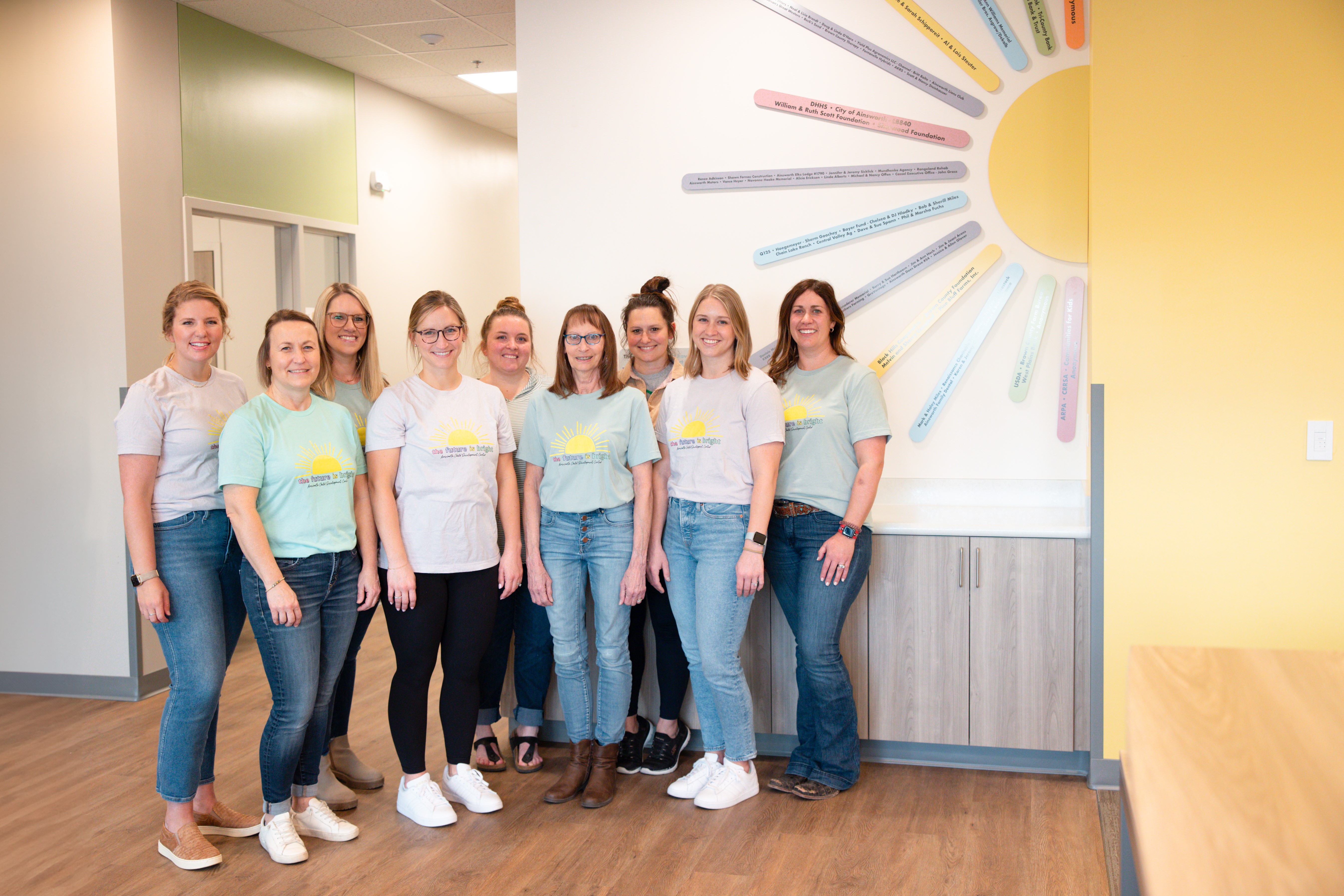
Like so many small communities across Nebraska, Ainsworth has a problem with maintaining quality childcare options. Karen O’Hare and Devyn France, both transplants to the Brown County community, describe their struggles with finding childcare when they moved to the town.
France, who moved to Ainsworth in 2018, said it wasn’t too hard to find care for her first child. However, when she had a second child a year later, it was clear infant care was going to be a problem. Her family found it even more challenging during the pandemic. She was deemed an essential worker in her position as Lab Manager at Brown County Hospital. Finding sustainable childcare was not an option. It was a necessity. O’Hare, who has a career in Crop Protection sales also realized during the pandemic that there were not enough options for childcare in Brown County for her children.
Covid wasn’t the root cause of the lack of childcare in the community, but it had worsened what was already a longstanding issue in Ainsworth. When France had to “puzzle-piece” care together for her children, one provider she was working with introduced her to O’Hare because she knew the two women were struggling with the same issue. At that time, several families in the area lost childcare due to multiple in-home providers closing. France and O’Hare along with several other mothers connected to form what is now the Board of Directors for the Ainsworth Child Development Center (ACDC), on which O’Hare serves as President and France as Treasurer.
O’Hare points out that just among the Board members, which include a 2nd grade teacher, a 3rd grade teacher, a retired preschool teacher, a banker, a local photographer/rancher and the local dentist, there were 9 children in need of care. From the start then, a childcare center was central to the discussion both because of the space needed and because, as France says, Covid showed them that local childcare was at the vagaries of in-home providers who might get sick or who might have to shut down due to lost revenue.
Soon Nebraska Children and Families Foundation’s Communities for Kids (C4K) joined the discussion, and their survey of the local area revealed a gap of 95 children under 5 who needed childcare. This, along with a town hall meeting showing childcare as a top issue, further underscored the need for a childcare center that would provide greater capacity to the community.
The Ainsworth Board explored buying land, which proved too expensive. A local citizen offered to donate a building but there were asbestos issues. The final solution came in a true community effort. The Board would buy the 7,500-square-foot building in downtown Ainsworth that used to house the company Technologent. However, it did not offer a green space where the children could play outside. Luckily, a local church owned a community building across the street that did offer a green space. The plan was hatched. The Board would trade spaces with the church, gut the 5,500-square-foot building, and build a new childcare center.

What remained to complete the plan was the monumental task of raising $2 million to fund the project. But as O’Hare puts it, “give a group of moms a problem that impacts their children and they will get it done.” O’Hare, France, and two other Directors formed a committee and set out to raise the money to fund construction while other board members worked tirelessly on finding grants and other funding opportunities. Meanwhile, Melissa Polinoski, Assistant Vice President of Early Childhood Programs for C4K And Technical Assistant to Ainsworth, facilitated planning for sustainability of the project.
It didn’t take long for the whole community to pitch in. While the project was in its early stages of fundraising, a local group of Latina women held an authentic meal fundraiser for the ACDC in a local community center taking free-will donations. Is this the most effective way of gathering such a large sum? Perhaps not. But here is why the community approach works. While local community members came in to enjoy the meal, a family pulled O’Hare aside and said they would like to donate funds to the ACDC in honor of their late mother, saying “this is a project she would have loved.” By the end of the day, the ACDC had a $7,300 check in hand from this “free-will donation” pop-up event.
Another example of such community spirit came from two radiothons held by the local KBRB radio station. In the first year, a donor offered $25,000 if Ainsworth residents would match it. Within the hour-long event, the community had pledged $32,000 for a total of $57,000. In the following year, 5 donors came together to offer the $25,000 match and again the community produced to create a total of over $50,000.
Throughout the process, Polinoski helped O’Hare and France plan for the future. Polinoski says about the success of the NCFF C4k initiative, “They always say about C4K, ‘The secret sauce is their technical assistance.’” O’Hare and France agree the level of commitment from C4K’s technical assistance is really what helped get their project across the finish line. With the help of Communities for Kids, the fundraising committee set up initial conversations with the William and Ruth Scott Foundation, the Sherwood Foundation, and the Buffett Foundation and made connections with other Nebraska communities for collaboration and support.
Results were immediate. The Brown County Foundation made the first large contribution while the Scott Foundation soon contributed the money to purchase the Technologent building. In addition, ACDC partnered with the Lund Company for project management. Together, they made the center a flagship for childcare centers in rural Nebraska.
O’Hare and France were tireless in their work not only to fundraise but also to make sure the specifics of the build were achieved. Polinoski says, “the scope of work these ladies are doing on top of being professional mothers having careers, it has been phenomenal to watch.” The Ainsworth Board raised the necessary $2 million in just under a year with no small help from C4K. According to France, C4K was responsible for introducing the group to $1.3 million of the total funding.
Once the fundraising goal had been met, construction soon began. Polinoski says, “an important aspect of this story is the amazing job that Ainsworth has done to rally the community themselves to get the center built.” The Ainsworth Board made sure to hire all local contractors to keep funds within the community. The community, in turn, gave back. Local contractors donated labor to perform such tasks as putting in ceiling tiles and leveling the ground. The Board even held a volunteer day that turned into a week in which community members could donate time for parts of the project that didn’t require skilled labor. Under supervision, volunteers lay flooring, hung cupboards, put in countertops, and performed other such tasks for a total of between $50,000 and $70,000 savings on the overall project.
Outside the building, the city of Ainsworth signed a long-term agreement allowing access to 25 feet of land adjacent to the building’s green space so that the new center would have 50 total feet of outdoor play space. The Board utilized community connections, and volunteers to acquire and transport donated turf that had been donated from a Nebraska high school sports fields to use for the play area.
When the center opened on March 11, 2024, it had been roughly 4 years from idea to completion. The new center has capacity for 12 infants, 12 toddlers, and a combined room of 22 total 3 and 4 year olds. It employs 9 full-time staff and 4 part-time staff.
Now begins the process of sustainability. Polinoski says as the group saw the end of the build in sight, they “were always saying, ‘cutting that ribbon is just a new beginning.’” C4K and the Ainsworth Board thus continue to encourage local investment in infrastructure, in early learning scholarships, in training for and outreach to the workforce, but, most of all, they work to educate the public on how early childhood infrastructure impacts overall economic development for the community.
Polinoski recognizes the community for all they’ve done and calls the work a “truly grassroots effort” that speaks to the spirit of what C4K does. She says, “the 3 pillars of C4K are connect, utilize, and engage. They did all 3 to what I think is the best of any community’s ability.” Ainsworth identified a vital need that affected their children, families, and local economic development, they organized a varied group of stakeholders, they raised funds, and they built a facility that met the needs and wishes of their community. And as Polinoski puts it, “C4K was always there along the way to fill in the gaps when the team didn’t know how to complete them or where to go for help.”
Learn more about Communities for Kids
© 2024 Nebraska Children and Families Foundation. All rights reserved.

Nebraska Children’s mission is to create positive change for Nebraska’s children through community engagement.


 Growing the Good Life
Leave a comment