
“Women tend to laugh more and live longer than men,” says the woman on the stage. She’s gray-haired, bespectacled. She looks like a grandmother or a principal, and indeed she was an educator in the past. She moves away from the lectern and continues, “It’s not a competition,” and then under her voice, “but we’re winning.” T. Marni Voss is a comedian and the keynote speaker at Nebraska’s Communities for Kids (C4K) Convening Day 2023 (part of the Thriving Children and Families Conference), and she knows her audience. The large group of mostly women laugh. And they should—not just because she’s right, but because as she later says, “humor is a coping mechanism that enables us to manage life’s absurdities.”
The women and men gathered here to discuss the state of early childhood care and education in Nebraska do serious work. They are the educators, early childhood professionals, community leaders, and families that invest their time locally and statewide to address the gaps in the early childhood care and education system within the state. After all, according to Walter Gilliam, of the Buffett Early Childhood Institute, 91% of the state’s counties have insufficient childcare and “11 counties have no licensed childcare at all.” The work can be hard, rewarding, tiring, exhilarating, but in the end, all is done in the best interest of Nebraska’s families, children, and the childcare professionals who care for them. When things get tough, sometimes it’s laughter that gets you by.
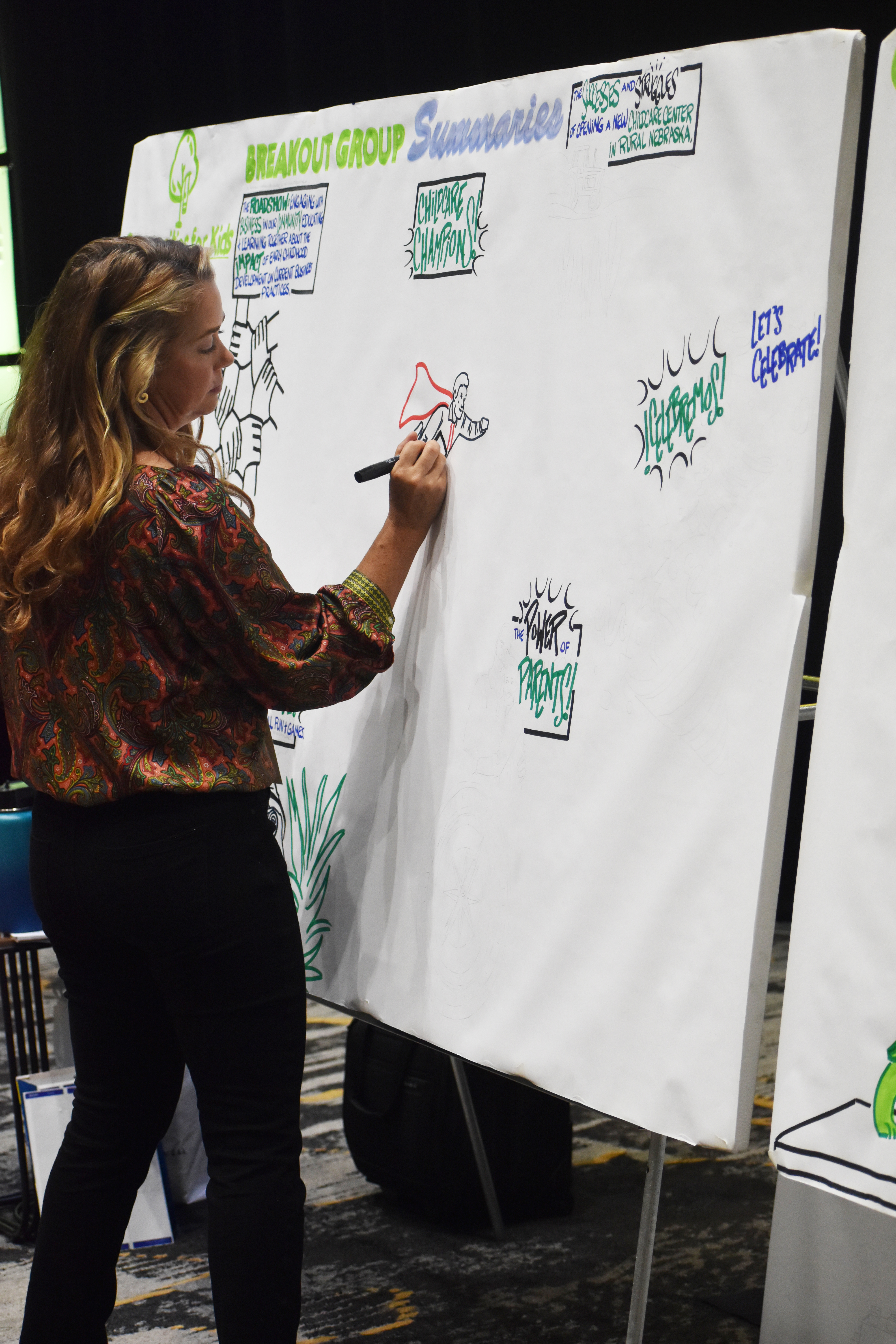
Perhaps that explains the somewhat carnivalesque atmosphere. A woman listens to each speaker and translates what she hears into a brightly colored palette of words and illustrations. There are elephants and butterflies, laughing children, cartoon chickens, a woman sitting in a flower—illustrations that all jump from the 4 x 8 canvasses where she draws in greens and reds and blues. There are the “Ted-style Talks” introduced by a Ted Lasso look-a-like. There’s the moment early in the day, when all pauses for the attendees to do the chicken dance.
But the work is real; the work is important. In one early session, mother-daughter duo Angie Luppen and Dalton Baber share the difficulties of converting an old church into a new childcare center in rural Kimble, Nebraska. They talk about the problems of getting contractors quotes, dealing with delays, repairing small things. But these are two women trying to open a childcare, not land speculators. Baber discusses “the statewide struggle” of staffing, pointing out that most of their staff of 12 are “high schoolers or fresh out of high school.” Luppen notes the difficulties of having to spend grant dollars by a deadline when contractors were not ready for the materials that the money paid for. She also points out the challenges of working with reimbursement grants when she and her daughter lacked ready cash to spend upfront.

Simultaneous discussions go on in other rooms. In one, a panel of two bilingual coordinators from Lexington and Hastings and the two providers with whom they’ve partnered speak of the work C4K has done to build trust among Spanish-speaking childcare providers. Together, they have successfully navigated licensing and operating a childcare business in a system where language can be a barrier. In another session titled “The Power of Parents,” a team of six parents from Ainsworth, Nebraska, shares how their lived experience led to a partnership with C4K that raised $2 million and resulted in the completion of the Ainsworth Child Development Center on Main Street of their small town.Simultaneous discussions go on in other rooms. In one, a panel of two bilingual coordinators from Lexington and Hastings and the two providers with whom they’ve partnered speak of the work C4K has done to build trust among Spanish-speaking childcare providers. Together, they have successfully navigated licensing and operating a childcare business in a system where language can be a barrier. In another session titled “The Power of Parents,” a team of six parents from Ainsworth, Nebraska, shares how their lived experience led to a partnership with C4K that raised $2 million and resulted in the completion of the Ainsworth Child Development Center on Main Street of their small town.
Later sessions include an innovative use of mobile “Think Make Create Labs” repurposed in Ogallala to bring early childhood games and activities to the community doorstep, an unfortunately necessary session on preparing young children for emergency response in their classrooms, and even a session on architecture and design of early childhood development centers. But laced throughout the day is the theme of community partnership; how communities, school districts, early childhood organizations, and childcare providers are working together to build local infrastructure that then can be connected across the state for a stronger more unified quality early childhood system.
One later session, for instance, addresses the partnership built between Laurel Concord Coleridge Schools and the Building Blocks Early Childhood and Family Development Center. Superintendent of Laurel County Schools Jeremy Christiansen presents the Bright Horizons Before and After School Program the community has established in an old church building and that was made possible by a collaborative effort. Key partners included Communities for Kids, Nebraska Children and Families Foundation, the Lund Company, and Wilkins. The innovative partnership allowed the district to take on functions, such as fiscal agent which includes the business and accounts payable responsibilities; human resources which includes advertising positions, training and paying staff through a cooperative fund; and recruitment and enrollment of families. This allows the Center to focus on the business of offering children and families the quality care they deserve.

The day ends with an activity that brings the two threads together: the lighthearted and the serious. Dr. Paula Thompson presents the Brain Game, which is designed to demonstrate the impact early experiences have on the development of a child’s brain. Attendees work in teams to build a developing brain’s architecture out of straws and multi-colored pipe cleaners. The aim is to build the structure as tall as possible. But the groups are thrown curveballs along the way. An early roll of a die, for example, determines how many sides the base can contain. As the teams build upwards random card draws introduce other complications in building and also add an element where weights must be hung from various parts of the structure.
Teams laugh and chat, obviously having fun with the challenge. But listen to what Dr. Thompson comments as they build the structures that represent children’s developing brains: “Neglect/violence creates toxicity in the brain. Fragility is created in the structure.” She speaks of the “tolerable stress” with which children sometimes cope and that requires childcare providers’ early interventions.
Yes, they laugh and chat and do the chicken dance, but they are involved in the very serious business of shaping children’s brains, of providing the systems of support and care that offer the earliest social emotional development and education children receive. They work together in communities to provide quality care for children. And they’ve seen success. C4K has leveraged $10.4 million statewide for early childhood work which has resulted in a rise in childcare capacity of 17%. Sixty-two percent of the cohorts that work with C4K have accepted early childhood care grants. They’re holding townhalls across the state to connect with leaders to build the kinds of partnerships in communities (like those presented in sessions) that make real and innovative changes for the early childhood landscape.
So with all the serious work they must do every day, why not laugh and have fun? T. Marni Vos says that “the sound of laughter fills us up. Laughter is healthy for us.” Throughout the day these rooms are filled with laughter. She goes on to say that “Humor is the shortest distance between two people.” Listen. The sound of connections being made among the fun-loving people doing serious business on behalf of children and families. The work is getting done, the distances are closing.
© 2023 Nebraska Children and Families Foundation. All rights reserved.

Nebraska Children’s mission is to create positive change for Nebraska’s children through community engagement.


 Growing the Good Life
Leave a comment